


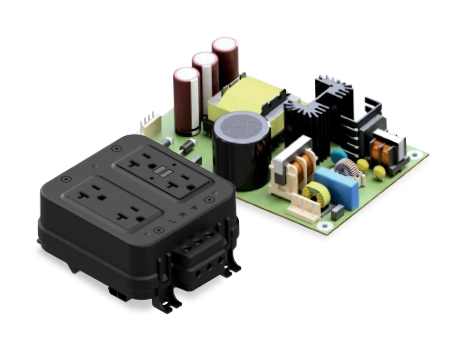
Power-conversion applications often involve unique electrical, control, thermal, mechanical, and regulatory requirements. ICE Components engineers custom solutions around defined system specifications and integration constraints.
Our engineers evaluate voltage, current, power, regulation, switching frequency, duty cycle, isolation, protection, and thermal requirements. We then define the topology, control method, magnetics, semiconductor stresses, thermal strategy, and mechanical architecture. Submit your project specifications below so our team can establish the design approach.
(Write none or n/a if the field is not applicable)
Power-conversion components cannot operate as independent design elements. Converter topology determines semiconductor stress, magnetic requirements, control behavior, filtering, and protection strategy.
Switching frequency creates another important tradeoff. Higher frequency can reduce magnetic size but may increase switching loss, EMI, and thermal loading. Lower frequency can reduce switching loss while requiring larger magnetic and filtering components.
Control response, load behavior, cooling, PCB layout, and mechanical constraints also influence overall performance. Coordinating these elements helps achieve stable regulation, efficient power transfer, controlled temperature rise, and dependable operation under transient conditions. When system requirements create competing electrical, thermal, or mechanical priorities, our engineering team can help evaluate the complete design and develop a coordinated power-conversion solution for your application.